
Selling B2B services in Poland: why translation fails to generate revenue?
Translating your sales deck into Polish covers the linguistics, but localizing your brand voice secures the revenue. In B2B market entry, a lack of cultural trust blocks deals far more often than poor grammar.
Don’t hand off your materials to a translation agency, or ask a local manager to blindly copy-paste HQ frameworks.
Instead, build a localized commercial narrative that actually closes deals.
The illusion of good enough translation

Many foreign headquarters treat localization as a basic administrative task.
They hire a translation agency, convert original assets into Polish, and expect local sales reps to immediately hit their quotas. Alternatively, they hire local Marketing Managers, ask them to design a custom market entry strategy, and then instantly block its execution, demanding the team replicate the Western European playbook (yup, I’ve been there).
In one of my previous roles leading a brand launch, I built a data-backed market entry strategy. Yet, the moment I started execution, HQ pushed back. They insisted on using stock photography featuring demographics that completely misaligned with the Polish reality, arguing that "it worked in other markets." A Polish consumer or B2B buyer will never resonate with a brand that visually ignores their everyday reality. You must actively decode local expectations and deep-seated frustrations.
Why cultural context outperforms perfect Polish
To succeed in Poland, your commercial communication must reflect how local decision-makers actually evaluate risk and purchase solutions. The Polish B2B buyer differs significantly from Western market personas:
Pragmatism over visionary promises
Western sales decks are often filled with terms like "disruptive," "revolutionary," and "amazing." Polish C-level executives are highly analytical and naturally skeptical of overly enthusiastic marketing. They demand to know how your tool integrates with their legacy systems and expect a clear ROI calculation.The demand for local proof
Dropping global Fortune 500 logos on a slide won't close the deal. Since you don't have local Polish case studies yet, your strongest proof is market comprehension. A Polish buyer will trust you only if you can articulate their specific local roadblocks and regulatory hurdles better than they can themselves.Directness and substance first
Polish B2B buyers have zero patience for fluff. They want to get straight to the pricing model, the implementation timeline, and the SLA (Service Level Agreement). Hiding these details behind vague corporate speak creates immediate friction in the buying process.
The real cost of focusing on translations, not localization
When your messaging fails to build cultural trust, the impact goes far beyond low website traffic or a few ignored emails. It directly disrupts your commercial operations. Many HQ executives look at their Polish sales data and assume the market is simply difficult/saturated or that their local sales reps are underperforming.
In reality, they are equipping their teams with ineffective, culturally disconnected tools. A mismatched commercial narrative creates structural leaks in your revenue pipeline.
Here is the exact operational and financial toll of poor localization, and the RevOps fixes required to repair it.
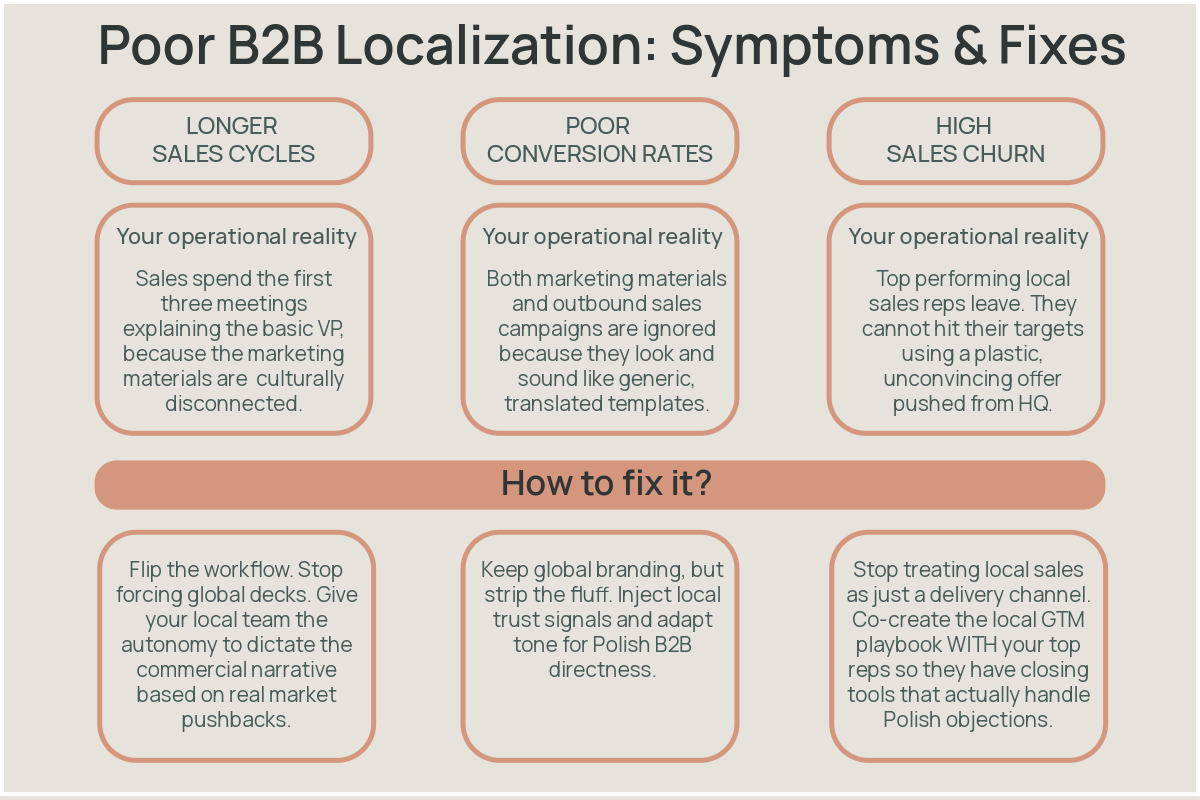
As the framework illustrates, fixing your communication pipeline is not about hiring better translators or redesigning a PDF brochure. It requires a structural shift in how your HQ and local teams collaborate.
If your top-performing sales reps are embarrassed to send your official collateral to a prospect, your marketing and sales are operating in silos. You cannot fix a localized sales problem with a top-down corporate mandate. You fix it by rebuilding your commercial infrastructure from the ground up, giving the steering wheel to the people who actually face the Polish B2B buyer every single day.
The Market Entry Playbook: Where to Start on Monday
You know the system is broken. Now you need to fix the pipeline. Instead of initiating a six-month, expensive corporate localization project, take these three immediate steps (with your Sales and Marketing team):
Step 1: Audit the Frontline Pushbacks
Stop creating new content. Sit down with your Polish sales team and document the exact objections they hear in the first 15 minutes of a meeting. Find out what specifically makes the prospect say, "That won't work here." Those raw objections are the foundation of your new localized strategy.
Step 2: Formulate a Local Point of View (PoV)
Since you lack local case studies on day one, your competitive advantage must be market comprehension. Take the pushbacks from Step 1 and build a commercial narrative that proves you understand Polish regulatory, operational, or financial hurdles better than the local alternatives.
Step 3: Ship the Minimum Viable Sales Asset
Don't wait to translate your entire website. Arm your sales team immediately with one surgically precise asset (e.g., a 3-slide PoV pitch deck or a single email sequence) built entirely around local operational realities. Test it in the field, measure the conversion, and iterate.
Is your global messaging costing you deals?
When your sales team in Poland generates activity but fails to close, look directly at your localized trust.
If you are tired of pushing generic strategies that fail to convert on the Polish market, let’s audit your commercial communication and build an infrastructure that actually drives revenue.
Stop losing deals to local competitors. Book a discovery call with me to audit your Polish Go-to-Market execution, align your brand narrative, and eliminate the internal team dependencies holding your sales back